

Accelerating Business Transformation:
Robotic Process Automation:

How Robotic Process Automation (RPA) Drives Business Transformation Through Adaptability and Innovation
Business transformation, led by adaptability, innovation, and growth, has become the cornerstone of organizational success, and robotic process automation (RPA), the propelling force behind streamlined operations, enhanced efficiency, and unmatched accuracy, has emerged as a game-changer for businesses seeking to succeed in this cut-throat digital era.
So, what is Robotic Process Automation or RPA?
Robotic process automation (RPA) is a technology that uses software robots or “bots” to automate repetitive, rule-based tasks in business processes. It can interact with computer systems, applications, and data to perform tasks such as data entry, data extraction, calculations, and transaction processing.
Critical components of robotic process automation (RPA)
- Software robots (Bots): At the heart of robotic process automation lie these digital assistants that execute with precision, consistency, and speed. They allow human bandwidth to focus on more strategic initiatives.
- Process automation and orchestration: Robotic process automation ensures seamless integration and collaboration between bots and employees by streamlining workflows and complex processes.
- User interface (UI) interaction: Robotic process automation interacts with applications through a user interface for quick and non-disruptive implementation.
How does Robotic Process Automation Benefit Business Transformation?
Robotic process automation benefits business transformation through increased efficiency, cost savings, enhanced accuracy, 24/7 operations, scalability, flexibility, better compliance, employee empowerment, shorter process cycle times, business insights, and improved customer satisfaction. It optimizes processes, drives efficiency, and empowers organizations to adapt to a rapidly changing business landscape.
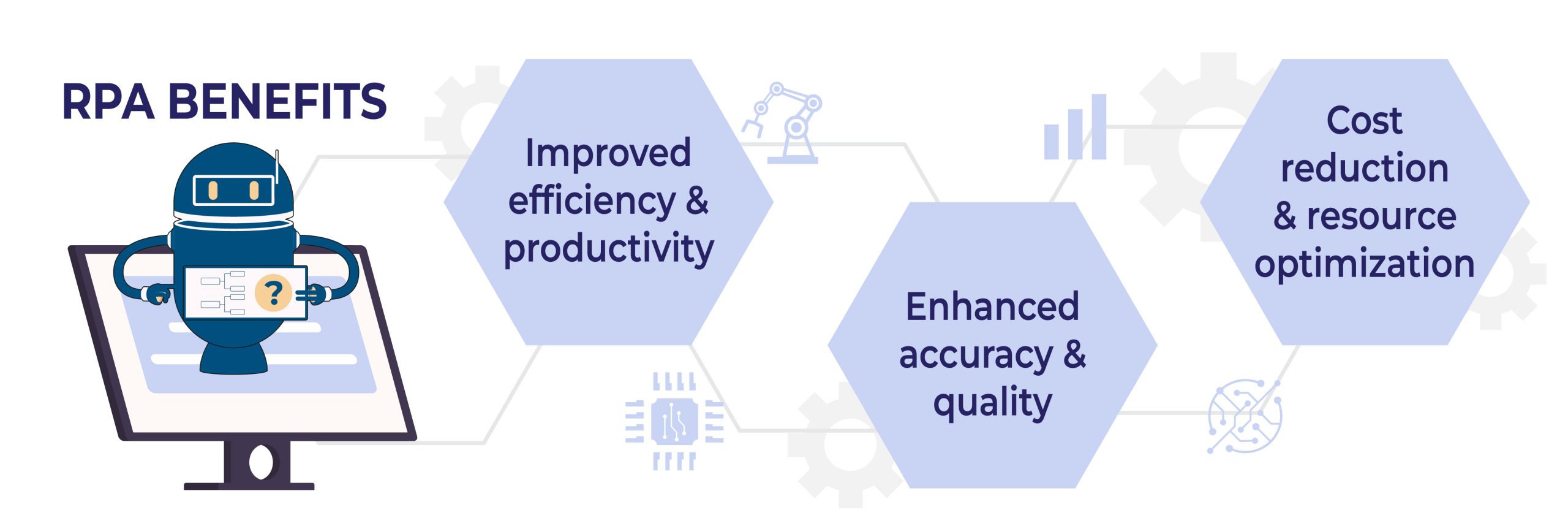
- Improved efficiency and productivity: RPA allows human resources to concentrate on higher-value and strategic activities by automating mundane tasks. This boosts overall efficiency and productivity.
- Enhanced accuracy and quality: By eliminating human errors, RPA ensures consistent, high-quality execution, translating to higher customer satisfaction.
- Cost reduction and resource optimization: Optimized use of resources combined with reduced manual intervention results in cost savings.
Identifying business processes for RPA implementation
Not all processes are ideal for business process automation. Repetitive, rule-based tasks with high transaction volumes are the hallmarks of processes that suit RPA, such as:
- Data entry and migration: Vast amounts of data can be processed accurately and swiftly, expediting data entry and migration tasks with zero compromises on quality.
- Customer onboarding and support: RPA empowers seamless onboarding and support processes and reduces response times, improving customer satisfaction.
- Order processing and inventory management: Automated order processing and inventory management boosts supply chain efficiency, leading to better inventory control and lower fulfillment turn-around times.
Is RPA worth the investment?
Accelerating business growth with RPA
RPA is undoubtedly worth the investment for businesses seeking enhanced productivity and efficiency gains. By automating repetitive tasks and streamlining processes, RPA significantly reduces operational costs and minimizes human errors, improving accuracy and data integrity. The initial investment in RPA implementation is often recouped relatively quickly through cost savings and increased productivity. Moreover, RPA’s ability to scale rapidly and adapt to changing business needs ensures long-term value and agility. Here’s how RPA can aid in accelerating the growth of your business.
a) Streamlining operations for scalability
- RPA streamlines inventory and supply chain management, ensuring optimal stock levels and minimizing disruptions.
- With sales and marketing automation, your business can allocate more resources to nurture leads, improve customer engagement, and drive revenue growth.
b) Enhancing customer experience
1. RPA facilitates personalization in customer interactions, tailoring products and services to meet nuanced needs and preferences.
2. Automation of feedback and survey analysis in real-time provides valuable insights to enhance product planning and service delivery.c) Innovation and decision-making
1. RPA enables real-time data analytics and customized reporting, empowering businesses to make informed decisions swiftly.
2. Streamlined market research and competitor analysis can help your business stay ahead.
Overcoming challenges in RPA implementation for business transformation
A business or process-wide transformation comes with its own sets of challenges. However, with curated change management programs, impactful training, open communication, and collaboration, businesses maximize the positive impact of RPA.
- Change management and employee engagement: Communicate the benefits of RPA to employees. Involve them in the implementation process, and provide adequate training.
- Data security and privacy: Implement robust security measures to safeguard sensitive data and maintain compliance with industry regulations.
- Integration with legacy systems and IT infrastructure: Avoid disruptions by planning seamless integration of the RPA solution with existing systems and IT infrastructure.
- Regulatory and compliance considerations: Comply with relevant industry regulations and standards for a smooth RPA implementation journey.
Future outlook of RPA in business transformation
The future is bright for businesses embracing RPA, as the technology continuously evolves hand-in-hand with advancements in artificial intelligence, machine learning, and natural language processing.
- AI and cognitive automation in business processes: AI will enable RPA-led processes to learn from data, making them capable of making smarter decisions. In contrast, cognitive automation will enhance the undertaking of more complex and sophisticated processes.
- Industry 4.0 and digital transformation: Integration with AI and ML will yield data-driven decisions. Customer delight, transparent supply chains, agile operations, and improved compliance are benefits that will follow.
Selecting the right RPA solution for your business
When choosing the right RPA solution, evaluate potential vendors on their offerings of scalability, ease of implementation, and support services. Vendor reputation matters as well. Conduct a thorough cost-benefit analysis to help understand a realistic return on investment (ROI) that can justify the adoption of RPA. Following best practices, such as starting with small pilot projects, cross-functional collaboration, and continuous measurement of success metrics, can lead to successful RPA deployment.
Robotic process automation (RPA) is the driving force behind accelerated business transformation. Organizations can future-proof their businesses by leveraging the technology’s capabilities to streamline operations, enhance customer experiences, and enable data-driven decision-making. RPA will remain at the forefront of business transformation efforts as technology advances. RPA is evolving by integrating developments such as AI, ML, cognitive processing, and data science. The future of business is here, and RPA is the gateway to unlocking your business’s path to success in this future. For more information on RPA implementation, talk to our experts.
Recent Posts
 Outsourcing IT to India: A Smart Choice for American Businesses
13/12/2024
In the rapidly evolving digital landscape, companies are always looking for innovative ways to optimize their operations, cut costs, and tap into the best talent available. One of the most effective strategies to achieve this is by outsourcing IT to India.
 IT Outsourcing for US Companies: A Blueprint for Excellence
13/12/2024
In today’s fast-paced global economy, IT outsourcing has become a cornerstone for US companies seeking innovation, efficiency, and cost-effectiveness. By leveraging the expertise of global talent pools, businesses can streamline operations and stay ahead in an increasingly competitive market.
 US Businesses and Offshore Software Development: A Formula for Success
12/12/2024
Offshore software development offers US businesses a powerful strategy to optimize costs while maintaining exceptional quality. By partnering with global talent, companies can access skilled professionals at competitive rates, significantly reducing development expenses.
 IT Project Outsourcing: Boosting ROI Through Strategic Partnerships
07/11/2024
According to Radix, employee spending on IT outsourcing is $132.10 billion in 2023, and it is projected to skyrocket to $777.70 billion by 2028, growing at a CAGR of 11.07%. This significant rise underscores the increasing importance of IT outsourcing as a strategic investment for businesses worldwide.
 Software Project Outsourcing: The Strategic Leap for Business Growth
07/11/2024
Software project outsourcing is a key strategy for businesses looking to accelerate growth and stay ahead in a competitive market. In this blog, we will discuss how outsourcing software development can provide access to specialized skills, reduce operational costs, and enable scalability.


